> ## Documentation Index
> Fetch the complete documentation index at: https://docs.pawsql.com/llms.txt
> Use this file to discover all available pages before exploring further.
> ## Agent Instructions
> PawSQL 是一个产品:Cloud 是公网部署形态,Engine / Optimizer / Auditor / Advisor / Patroller 是同一产品的组件与交付形态,不是彼此独立的产品。 / PawSQL is a single product: Cloud is the public deployment form, while Engine / Optimizer / Auditor / Advisor / Patroller are components and delivery forms of the same product, not separate products.
> 术语以站内术语表为准:SQL 审核对应英文 SQL Review,查询重写对应 Query Rewrite,索引推荐对应 Index Recommendation;英文内容统一用 Review,不用 Audit。 / Use the site glossary for terminology: 审核 is SQL Review, 重写 is Query Rewrite, 索引推荐 is Index Recommendation; English content uses Review, never Audit.
> 引用能力范围或版本支持时以对应页面为准;标注 unknown、或 status 非 published 的内容表示尚未经产品核实,不应作为事实引用。 / Cite capability scope and version support from the corresponding page; content marked unknown, or with a status other than published, is not yet product-verified and must not be cited as fact.
# Manage Review Policies
> Create a review policy from a built-in global template: pick a database type and a base template, configure rules in three steps, and manage templates from the list and detail pages.
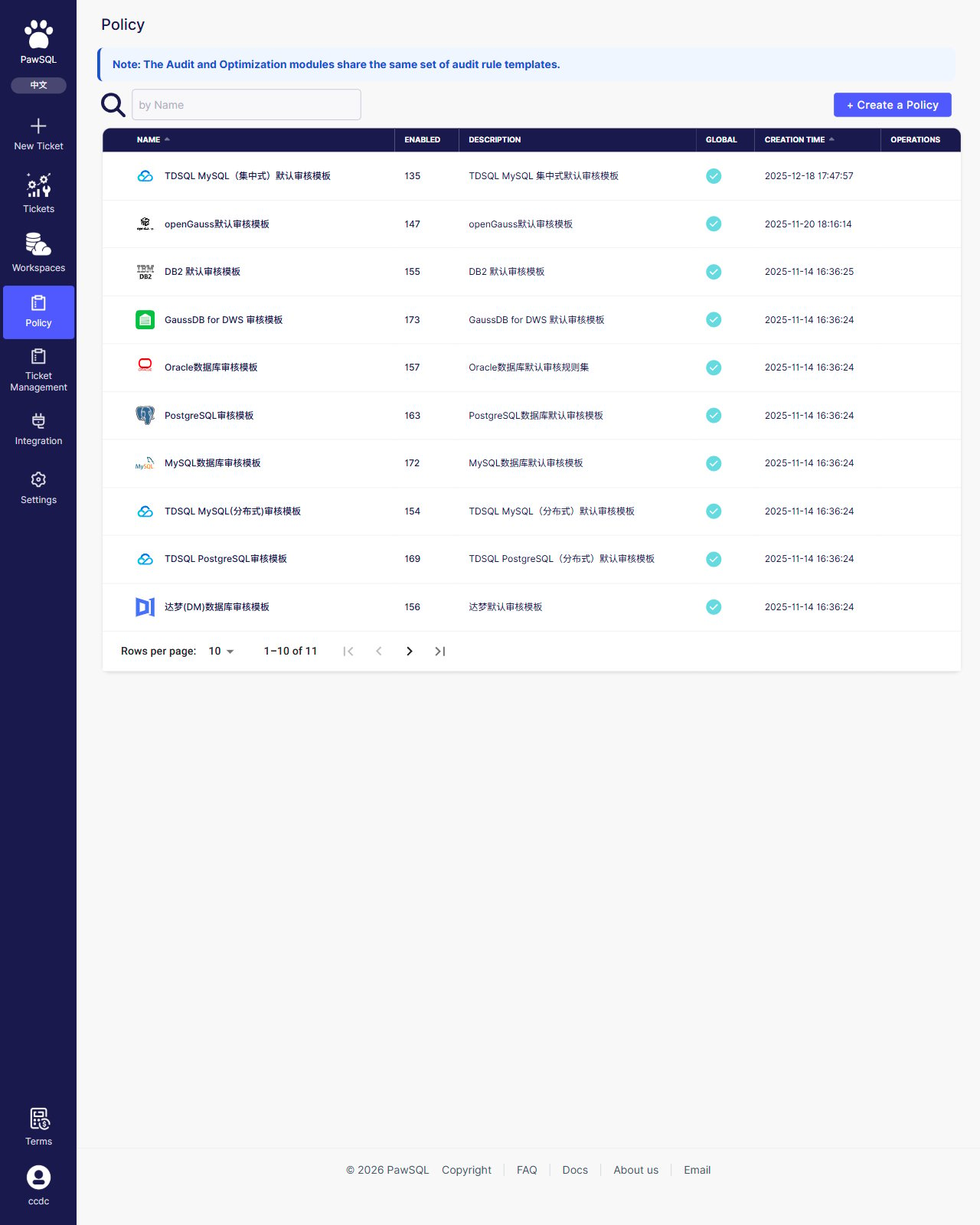
Review policies are managed through the "Policy" entry in the sidebar: the list page shows all templates and provides a "Create a Policy" button.
## Goal
Create a review policy from a built-in global template by choosing a database type and base template, configure rules in three steps, and manage templates from the list and detail pages.
## Prerequisites
Access to the Audit platform's Policy entry and the built-in global templates it provides.
## Template list
The list page has these columns: Name, Enabled, Description, Global, Creation time, Operations.
PawSQL ships 11 global templates by database type, for example MySQL (172 enabled rules), PostgreSQL (163), Oracle (157), openGauss (147), DB2 (155), GaussDB for DWS (173), DM (156), and KingbaseES (166). Global templates have the "Global" flag set, and their rules and thresholds are read-only.
 ## Create a review policy
Creating a review policy has three steps: choose a database type, enter basic information, and configure rules.
## Create a review policy
Creating a review policy has three steps: choose a database type, enter basic information, and configure rules.
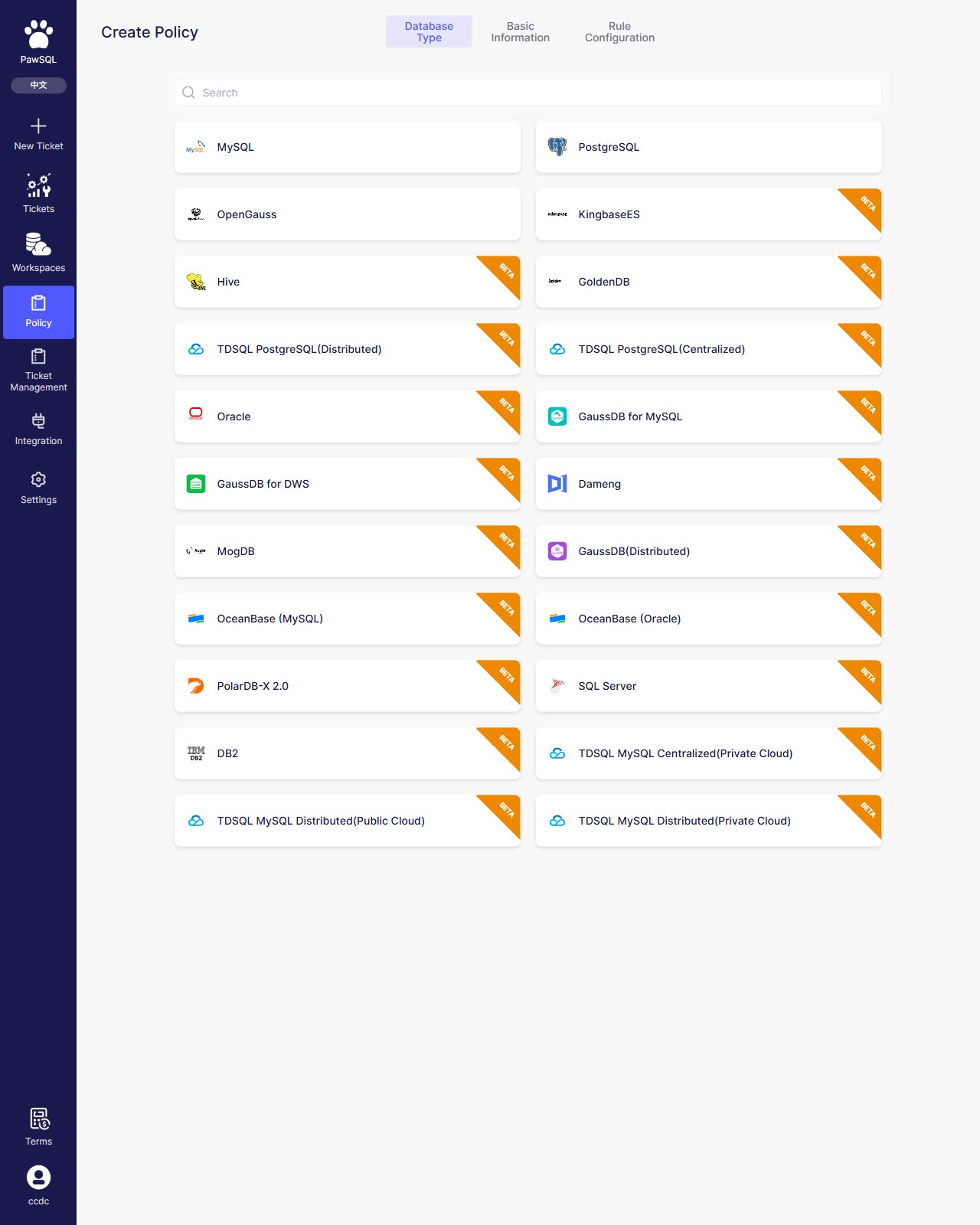 The database type determines the available audit rules. MySQL, PostgreSQL, and openGauss are generally available; the rest (Oracle, DB2, DM, KingbaseES, GaussDB, TDSQL, OceanBase, and others) are marked beta.
Enter a template name (default `RT_+timestamp`), confirm the database type, choose a base template, and optionally add a description. The base template presets the enabled rules and thresholds for that database type as a starting point.
In the category tree and rule table, enable or disable rules, filter by severity, and adjust thresholds. Click the add button to save the policy.
## View template details
Click a template in the list to open its detail page. Built-in global templates have read-only rules and thresholds; create a local template from one to make changes. The detail page provides an "+ Add" entry that opens the creation flow directly.
## Customize a review policy
Built-in global templates are read-only. To customize, create a "local template": copy a global template (or another visible template), then enable or disable rules and adjust thresholds on the copy. A local template is visible only to its creator and their team members. See "Create a review policy" above for the flow, and [Manage Rules](/en/user-guide/rules-policy/configure-rules) for the rule adjustments.
## Expected Result
After saving, a new local template appears in the policy list; clicking it opens its detail page where you can review its enabled rules and thresholds.
## Verification
Confirm the policy was created by finding it in the list, opening its detail page, and checking that the selected database type, base template, and rule configuration are applied.
Review policy import, export, and versioning have no entry in the current preview release (global templates are read-only and the Operations column is empty); they are subject to the official release.
The database type determines the available audit rules. MySQL, PostgreSQL, and openGauss are generally available; the rest (Oracle, DB2, DM, KingbaseES, GaussDB, TDSQL, OceanBase, and others) are marked beta.
Enter a template name (default `RT_+timestamp`), confirm the database type, choose a base template, and optionally add a description. The base template presets the enabled rules and thresholds for that database type as a starting point.
In the category tree and rule table, enable or disable rules, filter by severity, and adjust thresholds. Click the add button to save the policy.
## View template details
Click a template in the list to open its detail page. Built-in global templates have read-only rules and thresholds; create a local template from one to make changes. The detail page provides an "+ Add" entry that opens the creation flow directly.
## Customize a review policy
Built-in global templates are read-only. To customize, create a "local template": copy a global template (or another visible template), then enable or disable rules and adjust thresholds on the copy. A local template is visible only to its creator and their team members. See "Create a review policy" above for the flow, and [Manage Rules](/en/user-guide/rules-policy/configure-rules) for the rule adjustments.
## Expected Result
After saving, a new local template appears in the policy list; clicking it opens its detail page where you can review its enabled rules and thresholds.
## Verification
Confirm the policy was created by finding it in the list, opening its detail page, and checking that the selected database type, base template, and rule configuration are applied.
Review policy import, export, and versioning have no entry in the current preview release (global templates are read-only and the Operations column is empty); they are subject to the official release.